Showing posts with label social-software. Show all posts

Wednesday, October 23, 2024

I am accidentally breaching Facebook's code of conduct?

 My last post to this blog was about a hack to eliminate advertisements on YouTube. I could see why Google would object to the post because following the instructions given would eliminate some of their revenue. However, it seems that Facebook has taken grave exception to the post.

Whenever I post to my blog, I normally cross post a link to it on my Facebook page. This means that Facebook users can easily find the cotent. However, this time Facebook notified me that it had breached their community content guidelines. Specifically they said I "used fraudulent means to induce users to click like on another site". I was so puzzled by this accusation, I tried sharing the link again. This time the content was removed within seconds. I could not see any way to appeal the decision.

Does anyone know what I can do to get the article un-blacklisted?

Friday, August 15, 2014

Swarm v Foursquare

I have been using Foursquare for a number of years. In general I find this to be a useful and fun application for letting my friends know where I am, although many friends express puzzlement about why I would willingly disclose my location.

Recently Foursquare started encouraging me to try out their new Swarm application. Initially I was reluctant and stuck with the app that I already knew. However,they finally disabled check-ins with Foursquare and so I was forced to install swarm.

My first impressions of Swarm are quite positive - it looks like a nice upgraded version of the Foursquare app. However, I don't see why they had to split off check-ins into a new app. It seems that mashable agree with me.

Thursday, May 30, 2013

What tool do I use for interacting with Twitter?

Because, I am a frequent user of Twitter, many people ask me what is my favourite tool to use. I like to be helpful, but the reality is that I do not have a single favourite tool and I use many different tools depending upon the circumstances.

Luckily Twitter keeps a record of the tool that is used to publish each status update, so I decided to write a tool which would automatically analyse my feed.

The following table shows tools that I used for the 1,000 most recent tweets from my account (ignoring the tools which were responsible for less than 1% of the Tweets each):

Percentage Count Tool
31.67% 317 web
24.38% 244 TweetCaster for Android
11.49% 115 foursquare
10.79% 108 LinkedIn
4.00% 40 Tweet Button
3.70% 37 HootSuite
3.30% 33 Facebook
3.30% 33 Twitter for Android
2.50% 25 NetworkedBlogs
1.60% 16 bitly
1.30% 13 Flipboard

Another thing that people sometime comment upon is whether Twitter is a broadcast service or a conversational service. So I also looked at what percentage of my tweets were replies to other people (8.7%). However, almost half of my tweets (42.8%) are accounted for by retweets of content originally Tweeted by someone else.

An academic once told me that my social networking style was "to collect interesting information and share it with my friends". However, a more honest explanation would be that I am lazy and it is much easier to click on a "retweet" button than to think up original content to Tweet about.

My colleague Andy Stanford-Clark was recently featured on a list of Tech Execs that smart people follow and so I decided to compare his activity to mine. More than half of his tweets (67.5%) were replies to other people and retweets accounted for only 10.8% of his tweets. Therefore it is clear that he uses Twitter as a conversational service more than I do.

He also used a much smaller set of tools to interact with Twitter. He only used 8 different tools (as compared to my 18) and over half of all of his updates (65.4%) were done directly on the Twitter web site.

Percentage Count Tool
65.40% 654 web
8.80% 88 Twitter for iPad
8.70% 87 TweetCaster for Android
6.80% 68 txt
5.40% 54 Twitter for Android
4.70% 47 TweetChat
0.10% 1 HTC Peep
0.10% 1 Tweet Button

It is also interesting that Andy is a much more prolific user of Twitter than me. I had to go back as far as 23/Nov last year (about 6 months) to get 1,000 tweets from my feed, while I only needed to 10/April this year (slightly over a month) to get 1,000 tweets from Andy's feed.

It would be interesting to a similar analysis on a wider sample of Twitter users, because I guess there is no such thing as a typical Twitter user.

Saturday, February 9, 2013

[xpost] No longer a reluctant blogger after 7 years

I recently got a note about the plans to finally shut down the old BlogCentral blogging site. This was the first internal Blogging platform deployed in IBM and although it is technically still active, in recent years employees have been encouraged to use the blogging service that is bundled in IBM Connections instead.

The old service currently gets very little traffic and so it is no surprise that the service will be turned off - however, since blogs can be a useful historical record there is a plan to migrate content from the old service to the new one. In order to reduce the load on the migration tool, the administrators asked all blog owners to review their blogs and to delete anything that they didn't think should be migrated.

This is the first social networking site that I ever used, so I was a little bit nervous to see what embarrassing rubbish I had been writing back then. I saw that my old blog was called "Brian's Braindump" to reflect that I wasn't sure what I wanted to blog about (not much has changed there), but I was surprised to see that my first blog post was entitled "A Reluctant Blogger", and it was published almost exactly 7 years ago. In this initial post I explained that I didn't really see the point in all of these social networking tools and that I was only establishing the blog due to peer pressure of colleagues telling me that this would be the next big thing and that I ought to try it out.

I suppose a lot has changed over the last seven years. While I might still struggle to explain my own motivation for using social networking tools, I definitely could no longer be described as a reluctant blogger. In fact I suppose that I have taken to the concept with the zeal of a convert. I wonder what I will be writing about in 2020 and what tools will I be using to write it?

Thursday, November 15, 2012

Is it a good idea to write about your work on your personal blog?

Recently I attended a presentation by Marie Wallace telling people how to "tackle" social media. She made the point that it is important to have a clear idea for what your goal is for using social media or else you won't achieve it. During the subsequent discussion it became clear that most of the people attending the talk were planning to write primarily about the things that they are working on and associated social networking and blogging primarily with  advancing their career. In addition they didn't really enjoy using sites like Facebook and preferred to only use sites like LinkedIn with a more business orientation.

I enjoy engaging on social networking sites and my motivation is more personal that career oriented, but the discussion caused me reflect to  upon my motivation is and what I blog about. As I looked through my old posts I noticed a post which I wrote about a year ago analysing my motivation and this is generally still accurate a year later. However, I was surprised how few of my blog posts mentioned IBM or the work I do for them.

At a rough count, my blog post fall into 3 categories:

  1. Roughly 20% have something to do with IBM or the projects I work on. I included anything vaguely work related in this category e.g. I wrote several posts about the Young Scientist Competition which are not really related to my work, but I counted them because I got involved through IBM's sponsorship of  the event. 
  2. About 50% were technology related posts that had nothing to do with my work (e.g. reviews of mobile phone  applications) .
  3. The remaining 30% non-technology related (e.g. expressing opinions about politics or sport)


Since I spend well more than 20% of my time thinking about my work I would have predicted  that (due to simple statistics) a higher percentage of my output would be work related.

I make no secret about what I work on, but my reasons for not writing about work relate to two main reasons:

  • If I write about IBM or an IBM product I find it rad to get the right balance. If I a praise the company too highly it sounds contrived, but if I am too critical of an IBM product/policy it might have negative consequences too.
  • It takes me longer to write about a work related product because I feel that people will expect me to be accurate and check all of my facts. For example if I was to write a technical article for DeveloperWorks about a product I was working on, I would typically expect to spend several weeks getting it exactly right. In contrast I can write a comparison between RunKeeper and MyTracks in a much shorter time and I don't feel obligated to double check any of my statement since I don't claim to be an expert.

After reflecting upon this a little, I decided to keep with my current balance of allowing personal posts to predominate on this blog. After all I have plenty of other forums in which to write about my work. If articles are published elsewhere about stuff that I am working on, I often promote them to friends and colleagues by sharing on Facebook and/or Twitter. Perhaps I in the future I will try remember to also cross post to LinkedIn, since this seems to be more popular with my generation.

Friday, August 10, 2012

Recognising SPAM comments on blogs

Like anyone who has been using the Internet I have often received SPAM emails, but it was only recently I encountered SPAM comments on my blog. The content of SPAM comments on blogs is very different from the content of SPAM emails and so I didn't instantly recognise what was happening - luckily Google has more experience of such practices and they immediately removed the SPAM comments before I even got to look at it.

SPAM emails typically try to trick the receiver to part with some money and/or click on a link which will infect your computer with some malware. The content is not always offensive, but it is certainly embarrassing to read about some of the alleged services being offered. Very few people who read a SPAM email would confuse it with a genuine email, but of course if the spammers send out enough emails they will surely find someone foolish enough to be tricked.

When I first established this blog, I was given the choice of implementing a policy that all comments would have to be approved by me before becoming visible on the site. I decided not to implement this policy because I was not too worried about the type of comments that user would leave. Until recently, my confidence in human nature was repaid and none of the hundreds of comments left over the last few years were comments that I would not have approved if I was reviewing them.


Since the same word is used for SPAM emails and SPAM comments, I foolishly thought that the content would be similar. However I recently discovered that the content of SPAM comments is surprisingly different from email SPAM, because all the authors are trying to do is manipulate their Google page rank by posting a link to their site on your blog. As a result the SPAM comment will deliberately be crafted to look at first glance as close as possible to a real comment.


My knowledge of the topic this changed about a 2 weeks ago ago when I received notification about a few surprisingly complimentary comments left on my blog. These comments were praising the quality of my writing and although I was surprised at how gushing the praise was, I didn't initially suspect that anything untoward was happening (bloggers typically have an inflated self-image and so I suppose it is not surprising that blog authors will often accept such praise at face value). However, when the trickle of such comments grew larger my suspicions arose and I began to look a little closer.

None of the comments were duplicates of each other, but they all followed a pattern. The comments were gushing in praise about the quality of the blog, but they would refrain from specifying what exactly made the content interesting (presumably because the comments were being left by some semi-automated process that doesn't involve actually reading the content). The comments would all end up with a line like "you might also be interested to read my blog" and then they would provide a link to their own site (but of course genuine comments also frequently end with a line like that).

When this flood of comments started, I was on vacation without convenient access to the internet. Therefore, about a week had passed before I investigated and about 40 of these comments had been left. Luckily the Google Blogger platform was intelligent enough to catch all but 2 of these as SPAM without me having to do anything. When I then reviewed all the comments from the previous year and I found only one which was a previous incidence of the same pattern (my naive self was pleasantly suprised at the praise, but my new Jaundiced eye brought me down to earth). So clearly my blog has been added to some list of "easy targets" for comment SPAM.

A sample CAPTHA
In the meantime, the flow of SPAM comments continues to grow even more frequent. Although it is good that the blogger platform automatically categorises them as SPAM and hides them, it is still a nuisance that I can do without. Therefore I have been forced to implement a captcha system to slow the flood.

I personally hate captchas because I find them very difficult to complete (perhaps it is my fading eyesight). However, I think that I will need to leave this defence mechanism in place for a while until the spammers go away to softer targets.

Sunday, May 6, 2012

Updating my exercise technology

I am a big fan of technology and I also love spending time outdoors exercising. Some people think this is an unusual combination, because the stereotype of a geek is someone who spends time indoors staring at their computer. However, technology and exercise go very well together as this presentation by Ted Vickey explains in detail how technology can help with your exercise regime.


I normally use MyTracks from Google to track my running and cycling. Although I am quite happy with the way it works, watching Ted's talk convinced me that I should be more adventurous and try something new. Hence I signed up for an acocount on RunKeeper and installing the associated applications on my phone.


My initial impressions of RunKeeper are quite good. It seems to be very easy to use and it has a very active eco-system of gadgets and applications that can enable you to get an even better experience. It seems to really emphasise the social encouragement aspects, for example after I first used it to record details of a cycle it sent me a congratulatory email for achieving a personal best.

The first difference that I noticed between the MyTracks and RunKeeper is the way they handle the periodic announcement of statistics. The MyTracks software announces the statistics in a normal sounding voice, but sometimes towards the end of a run I am tired and my concentration fades so the statistical announcements don't register properly. In contrast RunKeeper reads announcements very clearly and slowly (as if speaking to someone who does not have a good grasp of English) and this is much easier for a tired runner to grasp. However, while MyTracks pauses any podcast or music that is playing when it has an announcement to make, RunKeeper doesn't and hence it tries to speak over the background noise. Perhaps there is a setting that I will need to tweak.

I will write a more comprehensive review when I have more experience.

Thursday, October 20, 2011

My blog gets a new look

The blogger platform just released some new "Dynamic Views" and so I decided it was worth trying them out. One of the advantages of using a platform like Blogger is that you get these new features without having to do anything. The new template makes my blog look completely different with virtually no work required from me. Let me know what you think of the new look..

If you click on the down-arrow beside the "Sidebar" at the left of the page header you can even choose a completely different layout. I think some of them look really cool although I must at some stage make a few more tweaks to ensure it looks correct and maybe even add back in a few of my old widgets which seem to have disappeared.

Wednesday, February 9, 2011

The Irish General Election is really using social media

The campaign is now well underway for the Irish general election which will take place on 25th of February. One thing that has struck me about the campaign so far is how almost all candidates have finally appreciated the importance of leveraging the internet and social media tools.

I suppose much has changed in the four years since the last election. This report from the RTÉ Drivetime program reviews how the various candidates are engaging with social media - while some candidates are clearly more successful than others, all of them are trying to win the on-line battle.

The election reports on the nightly TV news is typically started with a summary of the political Twitterings of the day. Most of the relevant Tweets are tagged with #ge11 so it is easy to follow the conversation.

Wednesday, February 2, 2011

How I became mayor of my local Gym

Since a General Election has just been called in Ireland, many people might be wondering how to achieve elected office. Those of you who follow my Twitter stream might have noticed my recent tweet "I just ousted @ as the mayor of Westpoint Health and Fitness Blanchardstown on @ " and wondered how I achieved that.

This was actually achieved very easily compared to how difficult it would be to become a real mayor. I recently started to use a service called FourSquare which allows you to check-in to various locations to tell your friends where you are. Initially I was quite skeptical about the potential benefit of using such a service, but since it seems to be growing in popularity I said I would see what the fuss is about.

An obvious thing to worry about using a service like this is that you might not want people to know where you are at any particular time. However, this is not really an issue, since FourSquare only tracks my  location when I explicitly check-in to a location (typically by using an application on my phone). This is quite different from services like Google Latitude or Facebook Places which can sometimes be publishing your location without you being consciously aware of that.


Initially I did not use it much because I was not sure when I might want to publish my location but then I joined a local gym and decided that I ought to boast about that fact to my friends. In my first check-in, I did not realize that the Gym was already registered on Foursquare and so I accidentally registered it a second time. The next two times I visited the gym I check-in properly with FourSquare and hey presto I was declared to be the mayor (based upon the fact that I had checked-in more frequently than anyone else in the previous 60 days) and FourSquare automatically tweeted the good news on my behalf. I should point out that at the time I was the only person check-in to the gym on FourSquare, but the gym was packed so the most frequent person to check in on FourSquare is not really a good estimate for who is visiting the gym most often.

Will this service catch on? I think it probably will, because it combines a fun element. I saw that my predecessor as mayor of the gym tweeted "nooooooooooooooooooooo!" in reply to the news of me becoming mayor, so maybe FourSquare can encourage more visits to the gym as we battle for the mayorship.

Friday, September 3, 2010

The video recording of our talk at the Blogtalk conference is now available on line

I am delighted to see that the video for our talk at the Blogtalk 2010 conference is now available online. The recording is quite good quality although I must admit I hate hearing my own voice. We must have run over the time limit because some of the Q&A portion is not included in the recording.


Of course it is not just our talk that was posted. All of the other speakers were also recorded and most can be found here, but some are not yet online because it is taking some time to upload them (by the time you read this I am sure they will all be up)

Thursday, September 2, 2010

How much notice should service providers give their customers when the terms of service change?

One of the cool things about the Twitter service is the fact that they don't send many emails to their subscribers to let them know how wonderful their service is. They have a very unusual attitude in that they expect that the usefulness of their service should be able to speak for itself. Therefore when they sent me an email today entitled "Update: Twitter Apps and you" I decided to actually read the email.

It started out quite well:
Over the coming weeks, we will be making two important updates that will impact how you interact with Twitter applications. We are sending this notice to all Twitter users to make sure you are aware of these changes.
Then I read the next paragraph:
Starting August 31, all applications will be required to use OAuth to access your Twitter account.
At first it sounded reasonable, but then I realised that this email was being sent on 2nd of September!!! I know internet time is different from normal time, but how can they use the phrase "in the coming weeks" to refer to 2 days ago!!

Suddenly the penny dropped and I realised why BlueTwitSidebar stopped working with Twitter yesterday. I pinged the developer of this tool to let him know of the issue, but it turned out that he already knew about it becuase everyone was screaming at him.

Surely this is a very unfair way to treat users by telling them of a significant change in authentication policy after it has already been implemented :-(

Wednesday, September 1, 2010

Report on Blogtalk 2010 conference last week

A number of people asked me to write up a report on the Blogtalk 2010 conference that I attended last week. This was a really interesting conference with lots of interesting topics being discussed, but since most of the people there were really great at using social media tools and they were all posting commentary all the time I don't think I can do really much better than to point you at the very active Twitter feed for the conference using the hashtag #blogtalk2010 or Emer Lawn's excellent summaries of day 1 and day 2.

I will write up a few blog posts later on specific topics that came up during the conference, but my general impression was to be amazed at the amount of buzz and excitement which can be generated when a bunch of like minded geeks get together. I was also delighted to see that my Alma Mater NUI Galway is looking both completely new and modern, while at the same time being reassuringly familiar from 30 years ago (when we used to call it UCG).

You can see the slides for my own talk with Gabriela Avram below. It went down pretty well despite being in a bad slot as the second last presentation of the conference when everyone was tired (including the presenters). A number of the other presentations are also available on SlideShare, but there is no unified feed for them available (yet). I believe that the conference site will be updated shortly with links to all of the presentation and video's of the various presentations (every move was captured on camera).

Thursday, July 29, 2010

Is Twitter a conversational mechanism

I hear a lot of people says that Twitter is a great tool for enabling conversations. In my experience Twitter can be used for conversations, but it is far from ideal for this purpose. I think that what people are really saying is that they are surprised how much conversations happen on Twitter given that the platform was designed primarily as a broadcast mechanism (for distributing news about what you are doing).


A conversation takes place when a person reacts to what they hear someone else saying either by responding to the original speaker or by passing in the message they heard to others. In some ways, Twitter is seen as a replacement for email. In order to judge whether Twitter is more likely to be used for conversations than email I decided to compare the what percentage of the contents of my email inbox and my Twitter stream involve conversations. The results are summarised by the following table:

ChannelReTweets or ForwardsRepliesNeither
My Email Inbox
11%22%67%
My Twitter Feed 
11%4%85%

It is clear that I see much fewer conversations happening via Twitter than via email, because although 22% of the emails I receive are replies, only 4% of the Tweets that I read are replies (to my email or someone else's). It seems that both mechanisms are used equally good at spreading news because 11% of the messages on either format are forwarding an email from someone else or re-tweeting a message that someone else twittered.

These results are skewed by the fact that not all emails or Tweets come from normal people. Some of the emails I receive are from automated programs e.g. the automated software build system we use will notify when a new build is available. In a similar way, some of the Tweets appearing in my stream come from semi-automated sources e.g. the Irish Times feed is really just an automated series of links to news stories on their web site. I am not sure I am a totally normal person (if such a concept even exists), but I decided to analyse the statistical profile of what I write:

ChannelReTweets or ForwardsRepliesNeither
My Sent Emails 
14%64%22%
My Tweets39%18%43%

Although the numbers are different here, I still see that I clearly use email more for conversation than I use Twitter - the vast majority (78%) of my emails are either replies or forwards of someone else's message while only 57% of my Tweets involved either replying or forwarding someone else's message. I think that the relatively high percentage (39%) of my Tweets which are re-tweets of someone else message is an indication of the fact that I am not very confident that I know how to use this new medium and so I play it safe by re-tweeting other people's content whenever I find it interesting.

I don't claim to be an expert in advising people about the best way to use Twitter, but it is sometimes easier to identify people using the platform badly. I was amused to see the twitter feed for Poolbeg (an Irish book publisher). The feed was established on 16th of January and started off well with several tweets in the first few days, but at the end of the first week they posted a status message "Evening all - it's been a busy week for Poolbeg. Wine time now though!". Then there are no more tweets in the intervening 6 months. Clearly the person who was responsible for updating their Twitter account thought that drinking wine more interesting than Tweeting :-)

Saturday, June 19, 2010

A catch-22 in the Facebook friend process

Many people use Facebook only to maintain relationships with people they already know well, but one of the alleged benefits of the system is that it can also be used to make new friendships. Unfortunately there is a subtle but important catch-22 in the Facebook friending process which makes it impossible to decide whether or not I should accept friendship requests from people I don't already know.

Most people have set the security settings on their Facebook profile such that virtually nothing is visible to people who are not already recorded as their friends. As a result when I receive a friendship request from someone I don't already know I have no information on which to judge whether or not this is a person I would like to be friends with. Presumably the person in question doesn't mind me seeing their profile because if I accept their offer of friendship they will be revealed to me, so why doesn't Facebook reveal it to me as soon as the friendship offer is made? I know it would be possible for me to accept the offer of friendship and then reject it immediately afterwards if I didn't like what I read in their profile, but since it is considered very rude to unfriend people I normally play it safe and simply ignore such friendship requests.

Sunday, April 11, 2010

Clean-up of tags

I was looking at the tags widget on the right hand side of my blog and I was surprised to see that I have used roughly 90 different tags on this blog. Many of these are only used on a single post and it makes it difficult to see what this blog is about.

After some consideration I decided the content of this blog could be categorised into the following themes:
  • GTD
  • IBM
  • Innovation
  • Ireland
  • Life
  • Mapping
  • Open-Source
  • Social-Software
  • Tools
I went through the blog posts and found that I could add at least one of these tags to each of the blog entries. I didn't remove any of the old tags (except for mis-spellings), but in many cases the blog post already contained a more specific tag e.g. the post may have contained Galway or Dublin so I added Ireland or if the post  have contained the tag Ubuntu I added Open-Source. The tag Life was used as a tag for everything that doesn't fit neatly into any other categories.

I then restricted the tags widget to just show these main categories. In future I will apply at least one of these tags to all of my new posts. It will also allow me to monitor the volume of blog content about each theme. For example, I see that I have relatively few blog posts about mapping, but this is a topic of interest to me and so I intend blogging more about it in future.

Thursday, April 1, 2010

GTD Q1 Review

I have now been doing weekly reviews on my blog for 3 months and so I thought it might be time to asses who effective these have been.
  • The once thing that surprised me is to see that I have kept it up - this is surprising becuase I am not necessarily very good at persisting at things.
  • I also see that I have mixed results about getting my weekly goals achieved. However, I think that the potential for public embarrassment of having to write on my blog has often spurred me to complete some of my week goals that might otherwise have slipped. For example, I notice that sometimes I have a goal "blog about x" and the blog post about x is posted shortly before my weekly review. On the other hand, there have been situations where I have written "not done" beside an action item a few weeks in a row and this has forced me to be more realistic about the chances of completing this action item and I move it to the "Someday/Maybe" list.
  • I only include things worthy of mention in my weekly ToDo list in my weekly review. Many tasks repetitive but time consuming tasks are ignored when writing my weekly review. I think this makes sense, but sometimes I am disappointed when I see how few items of note I have actually achieved in a week.
  • Being a manager means that many of the things I do must be kept confidential - it is not just my privacy, but the privacy of others must be respected. However, whenever I have anything major to do, I normally find that I can write something on my weekly review blog post that makes sense to me and doesn't compromise the privacy of the people involved.
  • I don't think my weekly review blog posts make for interesting reading, but quite a few people have commented directly to me that they have read the posts and they have offered encouragement in my GTD quest. (I am not sure why people are so reluctant to post a comment to the blog).
  • I don't think I have yet hit upon the correct mixture of tools and process that make GTD work effectively for me, but I  think I am getting closer. I will probably settle upon using Lotus Notes, but with some adaption to make it easier for me.
In summary, I think I will keep up the week reviews (at least for now). I am really looking forward to attending the seminar that David Allen and Erik Mack holding next week for IBM employees. I think this seminar will be really relevant to my personal circumstances. In addition I think it is great to connect with other IBM employees who are also struggling with implement the methodology in a way that works for them.

Saturday, March 27, 2010

New Template Design

I noticed that it was difficult to read my last blog post because the site template I was using too much space for the decorations at the side and allocated a relatively small amount of space for the real content in my blog. Therefore I switched to a simpler template and I used the new Blogger in Draft Template Designer to tweak the column with to give as much space as possible to the actual blog content.

I think it looks much better now. Do you agree?

Using BlueTwitSideBar for microblogging on several platforms simultaneously

Since I am a user of several different microblogging platforms I have tried out several tools that help me manage my interactions on all of the platforms in one place. I recently came across a useful Firefox plugin called BlueTwitSideBar which is very handy because it allows you to manage your status updates from within Firefox. If you are like me you probably have Firefox running pretty much all of the time so using BlueTwitSideBar means I don't need to launch a new tool to read or write a status update. Unfortunately it is only available inside of IBM for now, but this might change in the future.

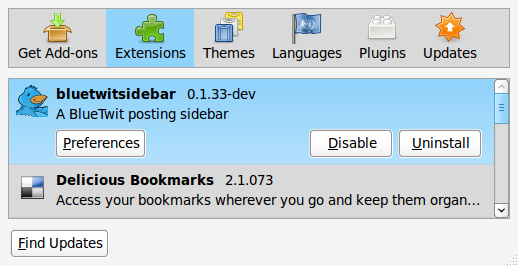
This plugin is fairly easy to use, but since there is no user guide associated with it I thought I would write up a short description of how to use it. The first thing you need to do after you install it is configure your settings. To do this you will need to select the Firefox menu option Tools\Add-ons.. which will bring up the following dialog showing the list of add-ons that you have installed.


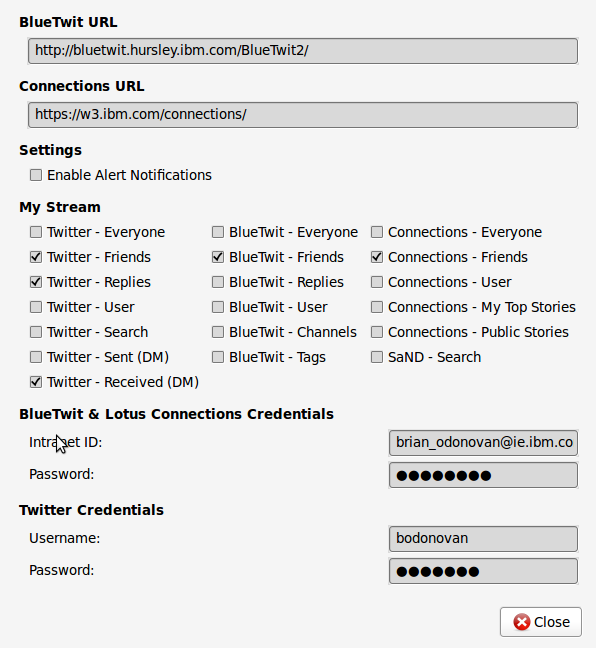
Clicking on the preferences button for BlueTwitSideBar will bring up the following dialog in which you specify  the details of the services that you will be using and the feeds that you would like to appear in your stream of updates. The URLs shown in the screenshot work for the IBM internal services.


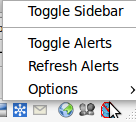
After you have installed and configured the plugin you will see a small icon at the bottom right of your Firefox window which shows you whether or not you have BlueTwitStattusBar Alerts enabled or not. If you have alerts enabled then you will get an alert window appearing every time someone sends an update to your stream (which I personally find annoying because the alerts are pretty constant). When you right click on this icon you see a menu to toggle alerts on or off, and you also see an option to open/close the BlueTwit Sidebar.


You can see below an example of what the sidebar looks like. The sidebar shows the updates in your various streams and you can also post an update simultaneously to the BlueTwit, Twitter and Lotus Connections Profiles service. You can choose the target platform(s) for each update by simply selecting the check box beside each icon.


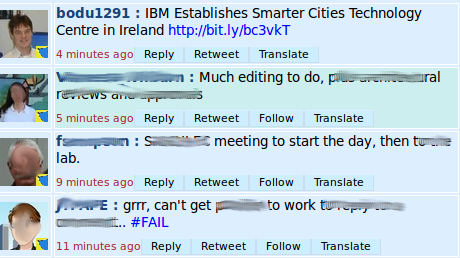
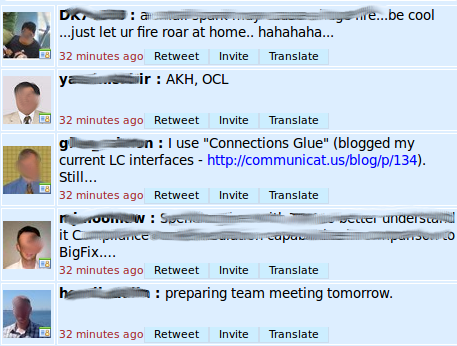
In the screenshot above I am sending an update to all three services at one. The two most recent updates are both on the Twitter platform - you can tell this because a small Twitter Icon is overlaid on top of the user's icon beside the tweet. The following screenshot shows what a few updates look like on the BlueTwit and Lotus Connections Profile service - I deliberately smudged part of  these screenshots since I cannot assume that the employees are happy to have their status updates seen outside the firewall.


You will see that as well as seeing the updates, you also get a few more options:
  • Retweet: Clickingon this button will simply copy the text of the update with the "RT @user" prefix into your status update box. You will get an option to manually edit the text before posting it (potentially to services other than the one the update was originally posted to).
  • Follow/Invite: Updates on the Twitter and BlueTwit services have a Follow button which can be used to add the user in question to your following list. If the author of the status update is already in your following list, the button changes to become an Unfollow button. The Lotus Connections Profile service does not allow people to follow anyone they want, instead their model is that you must invite people to your network and they must accept this invitation. Therefore the updates to the Lotus Connections Profile service have an Invite button in place of the Follow button.
  • Reply:Updates on the Twitter and BlueTwit services have a Reply button which can be used to compose a reply to this update i.e. it places @user at the start of a status update in your own update stream. The Lotus Connections Profile service handles replies slightly differently from the Twitter and BlueTwit services. Unfortunately BlueTwitSidebar does not (yet) implement a reply service for this platform.
  • Translate: Clicking on this button will invoke a machine translation engine to translate the text of the status update into your preferred language (in my case English). I don't know much about this, but it seems to work quite well for me. It translated a few  tweets from my Japanese colleagues, but since I don't speak Japanese I can't comment on the quality of the translation.

What do I think of BlueTwitSidebar
  • In general I think it is a very useful tool for keeping up with the different microblogging platforms I use.
  • I think that using a Firefox plugin is very handy for reading status updates, partly because Firefox is an application that I typically have already running when I decide to check status updates from my neotwork. It is also handy that when you click on links in status updates it does not need to launch a different tool to display the link contents.
  • One minor issue is that fact that ReTweets containing "@user" references can be confusing when the appear in another platform can be confusing. For example, if I posted something to BlueTwit and you decided to ReTweet it to Twitter, you would not be able to use the @bodu1291 as a link to my tweets, because my user ID on Twitter is @bodonovan.
  • Unfortunately BlueTwitSidebar does not allow you to use multiple instances of the same type of service. For example, if I use it to manage my interaction on the IBM Internal deployment of Lotus Connections Profiles, I can't also use it with the BleedYellos service.
  • The bottom line is that BlueTwitSidebar will be my tool of choice for now (but I am fickle and so this might change again if I can find anything better)

Saturday, February 20, 2010

Comparing Connections glue to StatusUpdater and WildFire

Connections Glue is a popular tool for keeping up with your Lotus Connections and Twitter networks. Following my earlier post where I compared Status Updater and Wildfire tools for doing the same thing a few people asked me to do a comparison between these tools and Glue.

I had never used Connections Glue before and so I found this video demonstration gave me a very quick look through the features:


The main difference between Glue and the two other tools is that it is implemented as an Adobe AIR application rather than a Notes/Sametime plugin. If you (like me) keep Notes and/or Sametime running on your machine all day long, it is handy to use a plugin for your microblogging, but if you don't a tool like Glue would be a much more light weight.

The main limitation with Glue is that it only supports Lotus Connections and Twitter. In addition it can only support a single instance of the Lotus Connections service (like Status Updater, but unlike Wildfire). However, in common with most AIR applications I have seen, Glue has  a very slick UI. I said before that the Satus Updater UI is smoother than Wildfire, but Glue takes things to another level:
  • When minimised Glue hides unobtrusively in the system tray
  • When new Tweets or profile updates are received in your network you are notified by a subtle semi-transparent pop-up which will dismiss itself after several seconds.
  • You can re-tweet the tweets you are reading with a single click.
  • When browsing through updates from someone outside your network you see a + sign which you can click on to add them to your network if you like.
  • Glue provides you with an interface to the files functionality in Lotus Connections as well as the profile updates.
In summary I think that Glue may be an interesting tool for users who don't normally keep Notes or Sametime running on their machines, but for anyone who does I think they would prefer either Wildfire (for non-IBMers) or Status Updater (for IBMers).