I am excited about the fact that IBM is planning to run a stand at the BT Young Scientists exhibition this January. This is a first for IBM (although the competition has been running successfully for many years).
I have volunteered to help run the stand. The details have not been worked out yet, but if you want to learn more about what is going on you can subscribe to the newly established blog site http://ibm4btyse.wordpress.com/, follow us on Twitter, or become a fan on Facebook.
Saturday, November 28, 2009


Wednesday, November 25, 2009
Teens prefer Facebook to Twitter because they want to waste time

Facebook (and social networking in general), was initially popular with teenagers before it gradually spread to an older audience. Even now the average teenager uses much more time on Facebook and similar sites than their parents.Twitter has initially become popular with an older age group and has not (yet) become equally popular with teenagers. For example, this survey reports that although 98% of 18-24 year olds use social networking sites, only 22% use Twitter. It is not immediately obvious why that should be so.

This report makes a convincing case that it is due to teenagers inherent narcissism, but I think that the explanation could be much simpler. Many of my contemporaries who have become fans of Twitter tell me that the big advantage of the site is that it takes them much less time to check out what its happening on Twitter. Older people have very busy lives, they would like to check out what is happening in their social circle - but they don't want to waste too much time on it. Twitter's simple interface ensures that it doesn't take too long to check it out.
I think that many teenagers are not overly busy and have lots of time to waste. I was looking at this interesting session from the O'Reilly 2.0 conference where they bring in a random selection of teenagers and interview them about their web usage. None of the teenagers use Twitter regularly. When they discuss why they don't use Twitter they seem to say that when they checked it out they could not see what the big deal was. Later in the interview they discuss why they like Facebook, one of the teenagers says that she loves the Facebook quizes because "they are a great way to pass tie when you are bored and have nothing else to do". I think this single sentence summaries the different attitudes.
Monday, November 23, 2009
Recent heavy rain in Ireland
Ireland's famous "40 Shades of Green" is only achieved with lots of regular rainfall so we are well used to dealing with rain. However, in the last week or so the rain has been much heavier than normal.
In Dublin we escaped the worst of the deluge - the only impact upon me was that I had to cycle to work by the regular roads rather than taking my preferred scenic route through the park (the path trough the park was partly under water).
As you can see in these pictures, other parts of Ireland had much worse flooding.

In Dublin we escaped the worst of the deluge - the only impact upon me was that I had to cycle to work by the regular roads rather than taking my preferred scenic route through the park (the path trough the park was partly under water).
As you can see in these pictures, other parts of Ireland had much worse flooding.
Sunday, November 15, 2009
Is Britain controlled by a powerful clique?
I have often heard it alleged that Britain is controlled by a clique of powerful people who are tied together by family relationships attended the same schools and are members of the same clubs. It is often hard to know if this is factually correct or not.
Channel 4 has recently launched a web site who knows who, which attempts to document the facts. The site grew out of research done for a program "When Boris met Dave" which examines the many links between Boris Johnson the mayor of London and David Cameron the leader of the conservative party. At first glance it is a very interesting site, but the interface is not very good. The maps do not seem to be visible at all in Firefox and even in Chrome the maps appear more flashy than actually useful. For example you can only browse from a single person, school or club and then navigating through their connections, but I would really like to be able to put in two names and have the system find the connections that exist between them (if any).
The data is far from complete. For example, if you relied on the information from the site you would think that only 8 people ever attended Eton College. However, Channel 4 are hoping that viewers will extend the data and have even suggested that they will Open Source the code behind the site in the future. I will be watching carefully to see how this evolves.
Channel 4 has recently launched a web site who knows who, which attempts to document the facts. The site grew out of research done for a program "When Boris met Dave" which examines the many links between Boris Johnson the mayor of London and David Cameron the leader of the conservative party. At first glance it is a very interesting site, but the interface is not very good. The maps do not seem to be visible at all in Firefox and even in Chrome the maps appear more flashy than actually useful. For example you can only browse from a single person, school or club and then navigating through their connections, but I would really like to be able to put in two names and have the system find the connections that exist between them (if any).
The data is far from complete. For example, if you relied on the information from the site you would think that only 8 people ever attended Eton College. However, Channel 4 are hoping that viewers will extend the data and have even suggested that they will Open Source the code behind the site in the future. I will be watching carefully to see how this evolves.
Thursday, November 12, 2009
Beware of XML PrettyPrinting Service
The XML file format has become very popular recently. One of the features that makes it popular is the fact that since .xml files contain plain text, they can be read by anyone using a simple text editor. This is very useful when you are trying to debug a complex system.
Unfortunately, many large XML files are not really readable because the files are too complex to be easily understood. This problem is made worse by the fact that many machine generated XML files try to save space by writing the XML as a single line without any spacing or other nice layout.
Recently I was trying to understand a large complex XML file and was a little frustrated that it was hard to see how the elements had been nested because no indentation had been used to help poor humans like me (software programs are generally unaffected by aesthetic concerns like this). I found this free on-line service for pretyprinting XML. At first glance it seemed to do what I wanted becuase it produced a nicely formatted XML file and displayed it to me in multiple colours.
Unfortunately when I copied the text back into my development environment, I discovered that the nicely formatted XML did not actually match the original and my program started to report XML parsing errors. There were two errors that I saw:
So be warned, prettier does not always mean better!!!
Unfortunately, many large XML files are not really readable because the files are too complex to be easily understood. This problem is made worse by the fact that many machine generated XML files try to save space by writing the XML as a single line without any spacing or other nice layout.
Recently I was trying to understand a large complex XML file and was a little frustrated that it was hard to see how the elements had been nested because no indentation had been used to help poor humans like me (software programs are generally unaffected by aesthetic concerns like this). I found this free on-line service for pretyprinting XML. At first glance it seemed to do what I wanted becuase it produced a nicely formatted XML file and displayed it to me in multiple colours.
Unfortunately when I copied the text back into my development environment, I discovered that the nicely formatted XML did not actually match the original and my program started to report XML parsing errors. There were two errors that I saw:
- The first error (which was easy to fix) was the fact that the XML file was tagged as using the utf-16 encoding while I was using utf-8 in my editor (probably they were using utf-16 on their web site so this was technically correct)
- The second error (which was tricker to fix) was when I had XML tags which were both a begin and end tag (for example using the syntax
) the pretty printer converted these into end tags (e.g. for my example they used which has a very different meaning and caused the XML parsing errors).
So be warned, prettier does not always mean better!!!
Sunday, November 8, 2009
How rapidly is Dublin Changing
People often remark how quickly Dublin is changing. A common complaint is that if you come back to Dublin after a gap of only 5-10 years you no longer know your way around due the number of new roads which have been built in the meantime.
South County Dublin County Council put together this interesting site to help people get a quick visual view of how the area has changed over the years. Users can start with a current map and zoom/pan to the area that interests them. With a single click of the mouse they can then switch to see one of many maps of the area produced since 1760.
As I clicked on various parts of the area and I was struck by the huge change in the map between the current day and the most recent historical map in 1942. For example Tallaght which now features a large built up urban area was only a small rural village surrounded by farms in 1942. It would be really interesting to see the changes in increments of every 5 years so that the detailed timeline of this change could be seen.
I was also struck by how little the map changed between 1760 and 1942. You can see that the style of map changed over the centuries as the practice of map making evolved, but the features on the ground seemed to change very little.
South County Dublin County Council put together this interesting site to help people get a quick visual view of how the area has changed over the years. Users can start with a current map and zoom/pan to the area that interests them. With a single click of the mouse they can then switch to see one of many maps of the area produced since 1760.
As I clicked on various parts of the area and I was struck by the huge change in the map between the current day and the most recent historical map in 1942. For example Tallaght which now features a large built up urban area was only a small rural village surrounded by farms in 1942. It would be really interesting to see the changes in increments of every 5 years so that the detailed timeline of this change could be seen.
I was also struck by how little the map changed between 1760 and 1942. You can see that the style of map changed over the centuries as the practice of map making evolved, but the features on the ground seemed to change very little.
Saturday, October 31, 2009
Does Ireland need more engineers?
Many commentators have stated that we need to increase the number of young people in Ireland choosing to pursue careers involving science and technology, but I don't think it makes sense to force youngsters into a career they don't find interesting.
It is true that many young people choose not to continue studying science at 3rd level because the subject has not been very well taught to them at 2nd level (where they tend to study it whether they want to or not). Many schools are forced to hire science teachers whose primary degree was not in science because the science graduates tend to follow more rewarding careers elsewhere. Also a lack of resources forces many schools to teach the subject from books instead of allowing student to learn by doing enjoyable hands-on experiments. This is something which needs to change.
Most science experiments involve building gadgets which is something most youngsters enjoy. It is also possible to design safe experiments which involve considerable amounts of explosions and objects crashing into each other. These are further aspects which most young people tend to consider an increase in the fun factor. It seems obvious to me that anyone who experiences a good science education will obviously choose to follow a scientific career if possible.
 However, I have recently come to a shocking conclusion - not all people poeple are like me!!! To my surprise some young people find accountancy, law and similar subjects to be more interesting than science!!!
When I initially realised this I was disappointed. However, on mature reflection I realise that it is good news that there are youngsters who have this attitude. It is inevitable that we will need some people to count the money and tell us if we need to tighten our belts or not. There will also be times when we need people to sort out our legal affairs. Is it not better to have these jobs done by people who genuinely enjoy what they are doing rather than by someone who is secretly pining for a more interesting job that involves science and technology.
People won't do a good job if they don't love what they do. I know that if the only career options available to me were in accountancy or law, I would probably manage to become competent enough in one of these disciplines to make a living. However, I would certainly not be as enthused by either of these areas of work as I am by my current career and I think this would be reflected in the quality of my work.
It is true that the invention of the internet and the radical advances in ICT technology over the last half century have really transformed the world. Because of these changes, everyone now needs to be familiar with the internet and how to use information technology if they are to realise their true potential. But this does not mean that everyone needs to work in the ICT sector.
This is analagous to what happened in the early part of the 20th century when the invention of the car transformed society in many wealthy countries. Almost everyone in these countries had to learn how to drive if they wanted to be successful, but not everyone was working in the automotive industry. Initially cars were very unreliable and so motorists were well advised to have a knowledge of how to do roadside repairs, but now cars have become so reliable that there is very little need of such expertise any more.
I think that computers have now advanced to the stage that there is no need for specialist knowledge of their inner workings in order to use them successfully.
A few years ago the poor state of camera technology and the multitude of complex incompatible standards meant that engineering students with a good understanding of the technology had an advantage over their colleagues in the humanities faculties with regard to posting videos to the internet. However, the landscape has now changed quite dramatically with the advent of cheap video recording equipment and sites like YouTube taking all of the complexity out of the process. Today the engineering students might be more familiar with the leading edge codecs, but videos attracting most attention on the internet are more likely to have been produced by humanities majors whose knowledge of video technology does not extend much beyond being able to correctly identify the record button on their camera.
I think that we do not need to force people into careers in the science and technology sector if this is not what they want. However, it is important that we should ensure that all students are familiar with how to leverage information technology for their field of work. For example, students of literature will inevitably need to use the internet to build an audience their work and it is important that they should understand how to do this. The publishing market is undergoing a a major transformation right now, so any good creative writing course should include topics such as "building on-line communities" and "understanding creative commons licensing"
Technology education also needs to be moved to an earlier point in the education cycle to reflect the fact that children are using the internet at a younger age than before. For example, most youngsters will be active on social networks before they leave primary education. For this reason most enlightened programs in Relationships and Sexuality should include a module on cyber-bullying.
It is true that many young people choose not to continue studying science at 3rd level because the subject has not been very well taught to them at 2nd level (where they tend to study it whether they want to or not). Many schools are forced to hire science teachers whose primary degree was not in science because the science graduates tend to follow more rewarding careers elsewhere. Also a lack of resources forces many schools to teach the subject from books instead of allowing student to learn by doing enjoyable hands-on experiments. This is something which needs to change.
Most science experiments involve building gadgets which is something most youngsters enjoy. It is also possible to design safe experiments which involve considerable amounts of explosions and objects crashing into each other. These are further aspects which most young people tend to consider an increase in the fun factor. It seems obvious to me that anyone who experiences a good science education will obviously choose to follow a scientific career if possible.
 However, I have recently come to a shocking conclusion - not all people poeple are like me!!! To my surprise some young people find accountancy, law and similar subjects to be more interesting than science!!!
When I initially realised this I was disappointed. However, on mature reflection I realise that it is good news that there are youngsters who have this attitude. It is inevitable that we will need some people to count the money and tell us if we need to tighten our belts or not. There will also be times when we need people to sort out our legal affairs. Is it not better to have these jobs done by people who genuinely enjoy what they are doing rather than by someone who is secretly pining for a more interesting job that involves science and technology.
People won't do a good job if they don't love what they do. I know that if the only career options available to me were in accountancy or law, I would probably manage to become competent enough in one of these disciplines to make a living. However, I would certainly not be as enthused by either of these areas of work as I am by my current career and I think this would be reflected in the quality of my work.
It is true that the invention of the internet and the radical advances in ICT technology over the last half century have really transformed the world. Because of these changes, everyone now needs to be familiar with the internet and how to use information technology if they are to realise their true potential. But this does not mean that everyone needs to work in the ICT sector.
This is analagous to what happened in the early part of the 20th century when the invention of the car transformed society in many wealthy countries. Almost everyone in these countries had to learn how to drive if they wanted to be successful, but not everyone was working in the automotive industry. Initially cars were very unreliable and so motorists were well advised to have a knowledge of how to do roadside repairs, but now cars have become so reliable that there is very little need of such expertise any more.
I think that computers have now advanced to the stage that there is no need for specialist knowledge of their inner workings in order to use them successfully.
A few years ago the poor state of camera technology and the multitude of complex incompatible standards meant that engineering students with a good understanding of the technology had an advantage over their colleagues in the humanities faculties with regard to posting videos to the internet. However, the landscape has now changed quite dramatically with the advent of cheap video recording equipment and sites like YouTube taking all of the complexity out of the process. Today the engineering students might be more familiar with the leading edge codecs, but videos attracting most attention on the internet are more likely to have been produced by humanities majors whose knowledge of video technology does not extend much beyond being able to correctly identify the record button on their camera.
I think that we do not need to force people into careers in the science and technology sector if this is not what they want. However, it is important that we should ensure that all students are familiar with how to leverage information technology for their field of work. For example, students of literature will inevitably need to use the internet to build an audience their work and it is important that they should understand how to do this. The publishing market is undergoing a a major transformation right now, so any good creative writing course should include topics such as "building on-line communities" and "understanding creative commons licensing"
Technology education also needs to be moved to an earlier point in the education cycle to reflect the fact that children are using the internet at a younger age than before. For example, most youngsters will be active on social networks before they leave primary education. For this reason most enlightened programs in Relationships and Sexuality should include a module on cyber-bullying.
Thursday, October 29, 2009
Your Twitter followers are not your friends
There has been a lot of excitement recently about the fact that Twitter have introduced a lists feature At first glance it seems similar to the Facebook feature where you can make lists of your friends. However, the comparison is not totally valid because Twitter uses the concept of a "follower" which is not the same as the Facebook of "friend". If you make the mistake of confusing your followers for friends, you will be making a big mistake.
Facebook was initially aimed at young people. The conventional wisdom is that it is dangerous for young people to speak with strangers, so the default setting in Facebook is that your updates can only be seen by people that are formally recorded as your "friend". Friendship is a two-way relationship, so in order to record a friendship link both users have to confirm that the friendship exists.
As everyone knows the term "friend" covers a wide variety of relationships. Robert Dunbar famously proposed that people can maintain a maximum number of about 150 real friends. However, a friend on Facebook just means "people whom I don't mind if they read my status updates". This is a very loose definition of friendship and many people who are very open can have hundreds and even thousands of friends on Facebook.
As everyone knows the term "friend" covers a wide variety of relationships. Robert Dunbar famously proposed that people can maintain a maximum number of about 150 real friends. However, a friend on Facebook just means "people whom I don't mind if they read my status updates". This is a very loose definition of friendship and many people who are very open can have hundreds and even thousands of friends on Facebook.
To help people who have large lists of firends, Facebook has a feature called lists. This is a way of recognizing the fact that not all friendship links are the same. For example, I might divide my friends into three lists named "family", "work-colleagues" and "drinking-buddies". This allows me to project a different image to each of the types of "friend". With careful use of the Facebook security features, I can ensure that members of my family will only see updates containing cute pictures of my children, my drinking buddies will see details of my wild revelries and my work colleagues only see updates which contain thoughtful insights in relation to our business. Of course the lists can overlap so that my brother who works for the same company and also joins my in my wild social life will see a complete picture of my activities.
Twitter does not formally record friendship in any way. By default all twitter updates are public and can be seen by anyone. It is possible to place access control on your twitter updates, but hardly anyone does that. Twitter has a concept of "followers". If you record the fact that you follow someone, this simply means that you want updates from that user to appear on the default page shown to you when you log into Twitter.
If any of my friends are on Twitter I normally add them to the list of people I follow - I am sure many of them also follow me. Most people follow this principle so there is a tendency for the "followers" network on Twitter to resemble the "friends" network on Facebook. However, a very significant difference is that while the "follows" relationship can be bi-directional it does not have to be.
Most people follow a similar number of people as who follow them and there is a large overlap between each group, but there are a few notable exceptions to this rule and these exceptions make a big difference to the overall structure of the network. For example, I follow the Irish Times feed to get notified of news stories, but the Irish Times does not follow me (the feed is probably produced by a software program rather than a real person anyway). Many influential Tweeters significantly change the flow of information through the Twitter network. For example, the software pioneer Mitch Kapor has 14,037 followers but is only following 322 people. Similarly the publisher Tim O'Reilly is only following 583 people but has 1,243,295 followers. It seems that there is probably a limit to how many people you can follow (the actual number depends on how much time you spend on Twitter), but there is no limit on the number of people who can follow you.
I created the following lists which grouped the people that I follow by the reason why I follow them. Obviously the lists are not mutually exclusive (e.g. I put any Irish journalist on both the journalists list and the paddies list):
When I initially joined Twitter I was anxious to build up a network and clicked the "follow" button quite liberally. As a result there were a few people on my follow list that I didn't really know who they were and hence I could not decide which list they should be on. I decided that it was probably best to unfollow these people. After this exercise, I see that of the people 157 who follow me, I follow 100 of them back. I think that this probably a good ratio, because it is not good to be in a clique where all of my friends are also friends of each other and we only talk to each other.
In general the lists feature makes Twitter more useful, but most importantly the exercise reminded me on the key difference between friends and followers.
Update: I just found this useful article which gives advice on how you can use Twitter Lists.
If any of my friends are on Twitter I normally add them to the list of people I follow - I am sure many of them also follow me. Most people follow this principle so there is a tendency for the "followers" network on Twitter to resemble the "friends" network on Facebook. However, a very significant difference is that while the "follows" relationship can be bi-directional it does not have to be.
Most people follow a similar number of people as who follow them and there is a large overlap between each group, but there are a few notable exceptions to this rule and these exceptions make a big difference to the overall structure of the network. For example, I follow the Irish Times feed to get notified of news stories, but the Irish Times does not follow me (the feed is probably produced by a software program rather than a real person anyway). Many influential Tweeters significantly change the flow of information through the Twitter network. For example, the software pioneer Mitch Kapor has 14,037 followers but is only following 322 people. Similarly the publisher Tim O'Reilly is only following 583 people but has 1,243,295 followers. It seems that there is probably a limit to how many people you can follow (the actual number depends on how much time you spend on Twitter), but there is no limit on the number of people who can follow you.
I created the following lists which grouped the people that I follow by the reason why I follow them. Obviously the lists are not mutually exclusive (e.g. I put any Irish journalist on both the journalists list and the paddies list):
- Journalists - this list contains professional journalists and official newspaper feeds (actually I originally mis-spelt this as "Jornalists" but I fixed it for fear of getting a reaction like Gordon Brown). I doubt very much if any of these people follow me back.
- Paddies - people who have some association with Ireland. Some (but not all) of these are friends of mine and might follow me back
- Gadgets - people who tweet about cool gadgets (mainly a subset of journalists)
- Linux - people who tweet about Linux and open source software
- Thinkers - people who write thoughtful articles. I know this is a list I might get some stick about, it could also be called a list of people whose opinion I value.
- IBMers - people who work for IBM
- Lotus Related - people who tweet about Lotus products and/or social software in general
When I initially joined Twitter I was anxious to build up a network and clicked the "follow" button quite liberally. As a result there were a few people on my follow list that I didn't really know who they were and hence I could not decide which list they should be on. I decided that it was probably best to unfollow these people. After this exercise, I see that of the people 157 who follow me, I follow 100 of them back. I think that this probably a good ratio, because it is not good to be in a clique where all of my friends are also friends of each other and we only talk to each other.
In general the lists feature makes Twitter more useful, but most importantly the exercise reminded me on the key difference between friends and followers.
Update: I just found this useful article which gives advice on how you can use Twitter Lists.
Tuesday, October 27, 2009
Are Powerpoint slides an essential part of every presentation?
There has been a lot of hype recently about the fact that PowerPoint celebrates its 25th birthday this year. The popularity of Microsoft's PowerPoint program has led many people to believe that it is not possible to give a presentation without having a slide show be presented on a screen behind the speaker. Strangely PowerPoint continues to be a big source of income for Microsoft, despite the fact that there are now many alternatives to PowerPoint available which are just as good and many are substantially cheaper (e.g. Symphony and OpenOffice are free).
Although most people use slides for their presentations, I notice that the best and most engaging speakers often don't use any.
Although most people use slides for their presentations, I notice that the best and most engaging speakers often don't use any.
- I recently give a presentation to the UK Lotus User Group without the benefit of any slides. Although I would not claim it was a brilliant presentation, it certainly was a much more interactive session than if I had been presenting a pre-prepared deck of slides.
- At a recent diversity conference within IBM, I noticed that the majority of the speakers simply used a single slide with their name and affiliation. Since the speakers were mainly speaking about their own personal life story and how they had managed to overcome discrimination it is not surprising that they could speak passionately about the subject without having to rely on reading out slides.
Thinking about this, I came up with the following observations about when sideshows are both good and bad.
- The slides can serve a useful reminder to the speaker about what they intended to say and/or they can serve a useful reminder to your audience of what you said if your circulate a copy to your audience.
- People often forget that it is possible to put something different on the screen from what is in the notes shown to the presenter. I strongly suggest that speakers should remember this because otherwise the audience will simply read your slides (quicker than you can speak) and tune out from listening to you.
- Many academics report that students read the slides in advance to decide whether or not it is worth their while to attend the lecture. For this reason some lecturers often deliberately leave out key facts from their notes in order to encourage attendance
- If you need to see the slides to remind you what you intended to say, it is a sure sign that you did not do enough preparation.
- The slides can discourage questions because they give the impression that the speaker has a tightly prepared script and does not welcome any interruptions. If you are presenting to a very large audience this might be good, but in most situations it would be better to encourage the audience to enter into a dialog about the topic.
- The slides help remind you whether you are going too fast or slow. Some people aim to spend 3 minutes talking about each slide. While it is bad to be so rigid in your timing, it is perhaps good to have some indication about whether or not you need to speed up or can afford to slow down (keeping in mind the points above that there should only be a loose relationship between what is on your slides and what you say).
Tuesday, October 20, 2009
Reunion a great sucess
The Loyola team was thrown into chaos before the start of the soccer match due to the fact that Eamon Maloney decided to follow Roy Keane's example and defected from the team because he felt he should have been captain. However, Paul Prendergast was only too happy to defect to the opposition and so we were able to start the match with seven players on each team.
When the match got under way it was Xavier's turn to panic. It soon became obvious that some of the Loyola team had diverted from the spirit of the competition by having kept their soccer skills honed over the last 30 year. Loyola built up a 3 goal lead. Luckily Xavier had the cunning to match the Loyola soccer skills and as soon as Cor MacDonagh made a few minor adjustment to the goals the match became much more level.
The match continued for longer than planned, because everyone was mentally thinking they were back in school and they were waiting for the bell to ring to indicate that it was time to go back to class. At the end nobody was sure exactly what the score was, but everyone agreed that they were thirsty and as soon as people had a quick shower we adjourned to Wards Hotel.
Several non-athletes joined us in the Hotel to make up a very respectable turn out. As the beer flowed, memories of our school days cane flowing back. Soon everyone was mentally back in their teenage years and it ws as if we were back in the Cellar bar 30 years earlier celebrating the night of the leaving cert results.
Here are some pictures that were taken by myself and WIllie Ruane (click on the pictures to be taken to more).
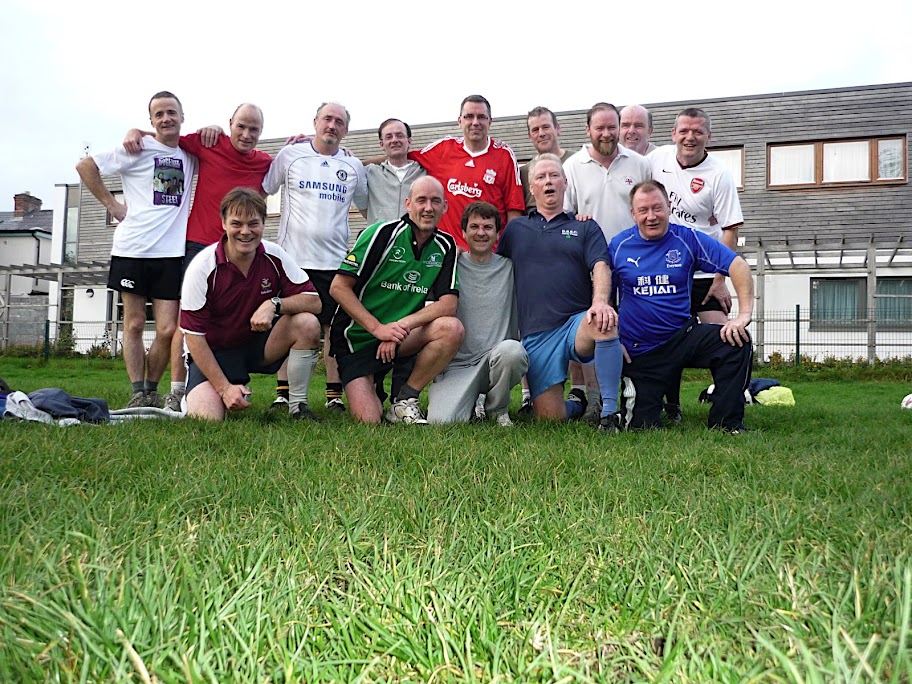

I was surprised that some people had not heard Willie's specially composed song for the reunion. Goto http://www.macjams.com/song/56041 if you want to hear it.
When the match got under way it was Xavier's turn to panic. It soon became obvious that some of the Loyola team had diverted from the spirit of the competition by having kept their soccer skills honed over the last 30 year. Loyola built up a 3 goal lead. Luckily Xavier had the cunning to match the Loyola soccer skills and as soon as Cor MacDonagh made a few minor adjustment to the goals the match became much more level.
The match continued for longer than planned, because everyone was mentally thinking they were back in school and they were waiting for the bell to ring to indicate that it was time to go back to class. At the end nobody was sure exactly what the score was, but everyone agreed that they were thirsty and as soon as people had a quick shower we adjourned to Wards Hotel.
Several non-athletes joined us in the Hotel to make up a very respectable turn out. As the beer flowed, memories of our school days cane flowing back. Soon everyone was mentally back in their teenage years and it ws as if we were back in the Cellar bar 30 years earlier celebrating the night of the leaving cert results.
Here are some pictures that were taken by myself and WIllie Ruane (click on the pictures to be taken to more).
I was surprised that some people had not heard Willie's specially composed song for the reunion. Goto http://www.macjams.com/song/56041 if you want to hear it.
Subscribe to:
Posts (Atom)